 CURRENT EDITION


US edition · Rules, worked cards & common mistakes
How to play Blackjack: rules and examples
Learn blackjack card values, soft hands, naturals, hitting, splitting and settlement with a worked example and clearly stated dealer rules.
Learn with a physical deck and no money at stake. Knowing the rules does not establish legal permission to gamble.
- Players
- 1–7 players plus dealer
- Deck
- One or more standard 52-card decks
- Goal
- Finish closer to 21 than the dealer without going over.
Blackjack compares each player separately with a dealer. Players do not need to beat one another. Use counters without monetary value while learning. This page describes a common hole-card game with a dealer standing on every 17, ordinary wins at one-for-one, and a two-card blackjack at three-for-two. Table rules can change these details, so the chosen baseline matters.
Play a practice round, step by step
- Assign values: numbered cards count their number, faces count ten, and an ace counts eleven unless that would bust the hand, when it counts one.
- Place the agreed counter stake. Deal two cards to each player and two to the dealer, with one dealer card hidden.
- Check dealer blackjack under the chosen hole-card procedure when the exposed card is an ace or ten-value card. Resolve naturals before ordinary player actions.
- On your turn, hit for another card or stand. An eligible double adds an equal stake and receives exactly one further card; an eligible split separates a pair into two separately staked hands.
- After surviving players finish, reveal the dealer hand. Draw below seventeen and stand on seventeen or more, including soft seventeen in this guide.
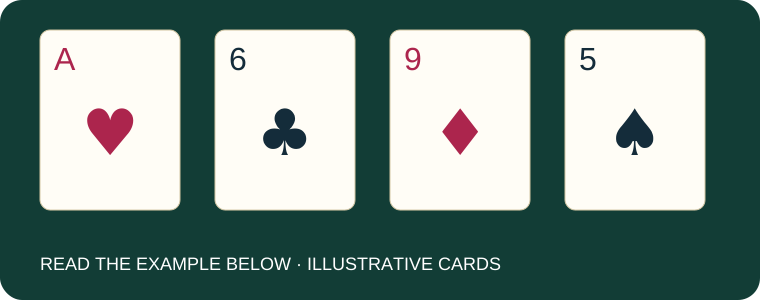
The ace and six initially total seventeen. If this is a player hand and the player chooses to hit, a nine makes the useful total sixteen: the ace now counts one. Drawing a five next produces twenty-one with four cards, not blackjack. Against dealer twenty it wins only the ordinary payout. With a stake of ten counters, an ordinary win returns the ten staked plus ten won; an original natural at three-for-two would return the ten plus fifteen. The illustration explains totals, not a recommendation to take those hits.
Settlement and exceptions
A bust loses immediately, even if the dealer later busts. Otherwise a dealer bust pays surviving hands. Higher totals win, equal totals push and return the stake. A natural blackjack is an original ace with a ten-value card; a three-card 21 or a 21 after splitting is normally an ordinary hand.
Specify permitted doubles, resplits, and split-ace restrictions before play. A useful teaching setup allows doubling any original two cards, one split only, and one additional card on each split ace. These are declared teaching conventions, not universal blackjack law. Insurance is a separate optional bet on dealer blackjack, not protection that changes your hand.
Reading soft totals
Call a hand soft when an ace can still count eleven without exceeding 21. Recalculate after each draw instead of permanently assigning the ace its first value. A hand can change from soft to hard without changing the physical cards already held.
For a practice session, give everyone the same stack and rotate the dealer after a fixed number of rounds. Record stake changes rather than simply counting how many hands someone won. A doubled loss changes a stack differently from an ordinary loss, which is why win counts alone do not describe a session.
Common misunderstandings
- A player bust is not rescued by a subsequent dealer bust.
- Soft seventeen rules must be announced.
- A split ace plus ten is ordinarily not a natural blackjack.
Agree the variant before starting
- European no-hole-card games alter checking and exposure of doubled or split stakes.
- Surrender and alternative blackjack payouts must be expressly agreed.
Rules and further reading
Educational synthesis with AI assistance. Source check: 25 October 2026. No federation endorsement or professional review is claimed.
All card lessons · Check local rules · Understand bonus conditions · Independent support
Your next useful step
- Card learning library
Choose a separate game lesson rather than applying Blackjack totals to poker hands.
- Local rules directory
A description of Blackjack rules does not establish local authorization to gamble.
- Independent support
Keep a route to independent help available without needing to continue playing.