 CURRENT EDITION


US edition · Rules, worked cards & common mistakes
How to play Gin Rummy: rules and examples
Learn Gin Rummy with sets, runs, deadwood, knocking, gin and undercut scoring, plus illustrated melds and a worked example for a two-player game.
Learn with a physical deck and no money at stake. Knowing the rules does not establish legal permission to gamble.
- Players
- 2
- Deck
- 52 cards; no jokers
- Goal
- Arrange melds and finish with less unmatched value.
Gin Rummy is a two-player exercise in arranging a hidden hand into valid groups while limiting the value left outside them. This lesson uses a ten-point knocking limit, a twenty-five-point gin bonus and a twenty-five-point undercut bonus. These are stated choices: published versions differ, so compare the scoring agreement before copying a result from another table.
Play a practice round, step by step
- Deal ten cards each and expose the next card beside the face-down stock. The non-dealer may take that upcard; if declined, the dealer may take it. If both decline, the non-dealer draws from the stock.
- On an ordinary turn, draw one card from the stock or discard pile, then discard one. A card just taken from the discard pile cannot immediately be returned to it.
- Arrange sets of three or four equal ranks, and runs of at least three consecutive cards in one suit. Aces are low; no card can serve two melds at once.
- You may knock after discarding when unmatched cards total ten or less. Expose your hand and melds. Knocking is optional; a hand with no unmatched cards is gin.
- After an ordinary knock, the opponent forms melds and may lay remaining cards onto the knocker’s melds. There is no laying off against gin in this version. End an uncompleted hand without score when only two stock cards remain.
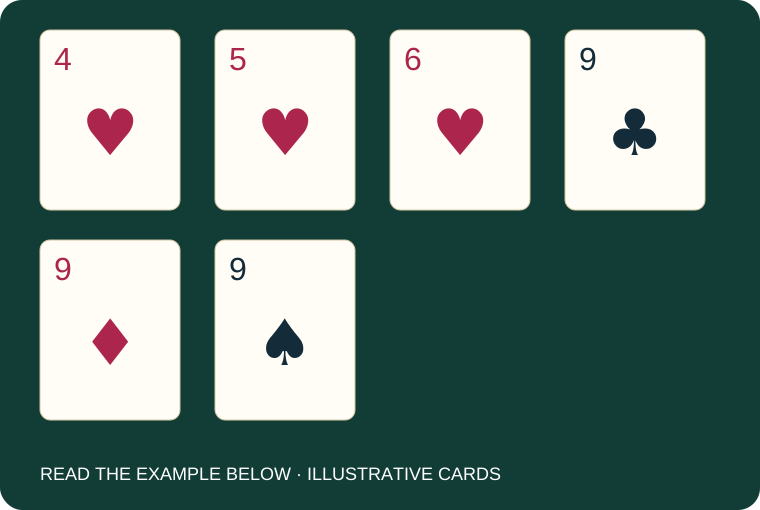
The hearts form a three-card run and the nines form a three-card set. Imagine the other four cards are a club two, diamond two, spade ace and club ace. They total six deadwood points, so the ten-card hand can knock after a legal discard has brought it to this arrangement. If the opponent finishes with fourteen after laying off, the knocker scores eight. If the opponent finishes with six, the tie is an undercut and the opponent scores twenty-five. Do not add the same heart five to a separate set while still counting the displayed run.
Counting the result
Aces count one, numbered cards their numbers, and pictures ten. After any legal laying off, an ordinary knocker with the lower deadwood total scores the difference. If the opponent ties or beats that total, the opponent undercuts and scores the difference plus twenty-five. Gin scores twenty-five plus all opponent deadwood. For this teaching match, stop when a player reaches one hundred and omit additional match bonuses.
Arrange the cards so the boundaries of every meld remain obvious. A helpful counting routine is to set deadwood beside, rather than inside, the runs. If one card could join either a set or a run, try the two arrangements separately. Photograph neither hidden hands nor an opponent’s choices; a paper note containing only the final totals is sufficient for reviewing a teaching game.
Compare a knock with a wait
For a practice decision, suppose your unmatched cards total eight. That makes a knock legal, but legality alone cannot tell you whether it will win. The opponent might have twelve after laying off, giving you four, or six, producing an undercut against you. The same visible hand can therefore produce different scores depending on the opposing hand.
Replay a sample ending with all cards visible. First prohibit laying off, then restore it and see which unmatched cards disappear. Keep this as a demonstration rather than an alternative rule for a scored hand. Its purpose is to show why the first deadwood total you count may not be the final one.
Common misunderstandings
- An ace cannot complete queen–king–ace.
- Deadwood is a value total, not merely a count of cards.
- A tie after an ordinary knock favors the opponent in this version.
Agree the variant before starting
- Bicycle describes different bonuses; do not blend its scoring with this lesson.
- Oklahoma Gin varies the knock limit and needs its own agreement.
Rules and further reading
Educational synthesis with AI assistance. Source check: 25 October 2026. No federation endorsement or professional review is claimed.
All card lessons · Check local rules · Understand bonus conditions · Independent support
Your next useful step
- How to play Six-card Cribbage: rules and examples
Separate points scored during play from combinations counted afterward.
- How to play Scopa: rules and examples
Try a table-capture game: matching values replaces trick-taking.
- How to play Five-card Draw: rules and examples
Learn replacement draws while keeping the completed hand private.
- Card learning library
Choose a clearly named rule set and practise with a physical deck without money at stake.