 CURRENT EDITION


US edition · Rules, worked cards & common mistakes
How to play Five-card Draw: rules and examples
Learn five-card Draw with blinds, the exchange, betting rounds and an illustrated two-pair example showing full houses, kickers and ties.
Learn with a physical deck and no money at stake. Knowing the rules does not establish legal permission to gamble.
- Players
- 2–6
- Deck
- 52 cards, no jokers
- Goal
- Improve five hidden cards through one draw and win the high-hand showdown.
Five-card Draw offers a compact introduction to poker: five private cards, one opportunity to exchange cards, and two betting rounds. This guide uses blinds and unrestricted opening hands. Family games may instead use antes, opening requirements, or wild cards. State those changes before the first deal, because they change the decisions a player can legally make.
Play a practice round, step by step
- Place a moving button, small blind, and big blind. Deal five cards face down to each player.
- Complete the opening betting round, beginning left of the big blind. Fold, call, or raise as appropriate.
- Starting with the first active player left of the button, discard chosen cards and receive the same number of replacements.
- Keep all five to stand pat. Separate discards from live cards and preserve each player's final five-card hand.
- Complete the second betting round starting left of the button. Show hands if multiple players remain; otherwise award the pot to the last player.
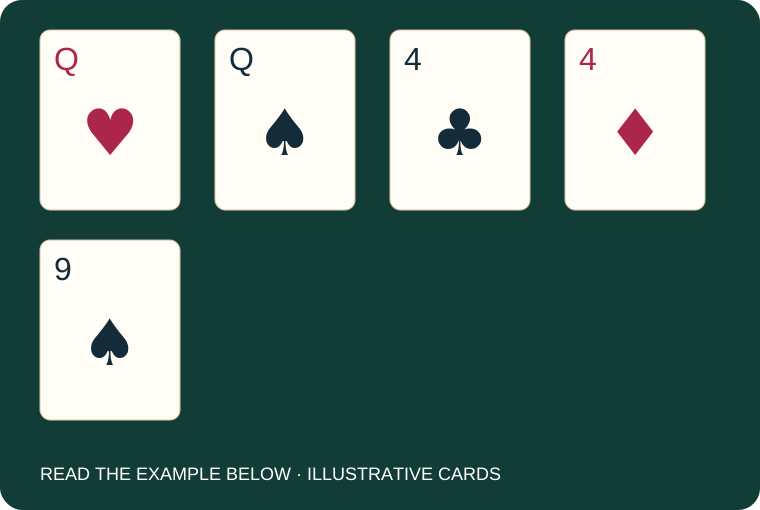
Keep both pairs and exchange the nine. Drawing Q♣ produces queens full of fours; drawing 4♥ produces fours full of queens. Both are full houses, but queens full is stronger because its three-card component is higher. Drawing A♦ leaves queens and fours with an ace kicker. That kicker beats a king kicker in another queens-and-fours hand, but cannot overcome an opponent's higher two pair such as kings and twos. The single exchange can improve category, improve a kicker, or leave the essential strength unchanged.
Hand comparison
Use ordinary high rankings: straight flush, quads, full house, flush, straight, trips, two pair, pair, high card. Compare the combination's rank, then relevant kickers. Suits do not break an otherwise exact tie.
Agree betting limits, maximum draw, and deck-shortage procedure before play. This baseline permits up to five replacements. A three-card draw cap, or an ace exception to such a cap, is a separate house convention. Do not improvise by returning someone their own discarded cards.
Reading the exchange
The number drawn is public; the replacements are hidden. A one-card draw can represent two pair, a straight draw, a flush draw, or another choice. A pat hand can be strong or a bluff. Those possibilities are information to interpret, not rules dictating a player's original holding.
For a teaching deal, expose one hand, discuss the discard, and then deal the replacement face down. Ask everyone to list the possible new hand categories before revealing it. Repeat with private hands once the exchange is understood.
The pot is the round's reward; a flush does not receive a fixed number of points. A weak hand wins if every opponent folds. At showdown judge only the cards retained after drawing, not the promising original combination a player remembers holding.
Choose a fixed number of practice deals and rotate the button consistently. Counting pot results rather than awarding informal points for attractive hands keeps the exercise faithful to poker while using counters with no monetary value.
Two-player exception
With two players, the button posts the small blind and acts first in the opening betting round. The opponent posts the big blind, draws first, and acts first in betting after each draw. This replaces the multi-player seat order described above.
Common misunderstandings
- Finish the draw with exactly five cards.
- Wild cards require an explicit rule.
- Standing pat is not proof of a made hand.
Agree the variant before starting
- Jacks-or-better adds an opening requirement.
- Ante Draw changes the forced-payment and action procedure.
Rules and further reading
Educational synthesis with AI assistance. Source check: 25 October 2026. No federation endorsement or professional review is claimed.
All card lessons · Check local rules · Understand bonus conditions · Independent support
Your next useful step
- Poker hand rankings: high hands, kickers and ties
Check the standard high-hand comparison, then notice which variants deliberately depart from it.
- How to play Deuce-to-Seven Triple Draw: rules and examples
Compare a different low-hand system: aces, straights and flushes change the evaluation.
- How to play Badugi: rules and examples
Study a four-card low-hand game where repeated suits and ranks affect the usable hand.
- Card learning library
Choose a clearly named rule set and practise with a physical deck without money at stake.