 CURRENT EDITION


US edition · Rules, worked cards & common mistakes
How to play Deuce-to-Seven Triple Draw: rules and examples
Learn deuce-to-seven Triple Draw with low rankings, three exchanges, betting limits and a worked example showing why straights hurt your hand.
Learn with a physical deck and no money at stake. Knowing the rules does not establish legal permission to gamble.
- Players
- 2–6
- Deck
- 52 cards, no jokers
- Goal
- Make the lowest five-card hand while avoiding pairs, straights, and flushes.
Deuce-to-seven lowball rewards hands that would be weak in ordinary high poker, but it is not the same low system used by Razz. Aces are high, and straights and flushes count against you. This guide describes fixed-limit triple draw, with single draw explained as a separate variant. Three exchanges create four betting rounds and several opportunities to stand pat.
Play a practice round, step by step
- Post small and big blinds beside the moving button, then deal five hidden cards each.
- Bet before the first draw, beginning left of the big blind.
- Starting left of the button, each active player exchanges any number of cards, including zero, and then bets.
- Repeat the draw-and-bet sequence twice more, for three draws altogether. Use small bets in the first two betting rounds and large bets in the final two.
- At showdown compare the lowest five-card hand using deuce-to-seven rankings, or award the pot earlier if only one player remains.
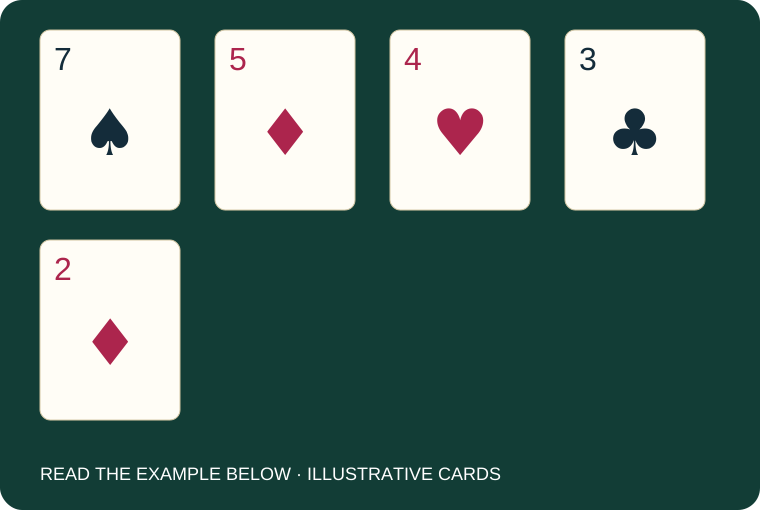
Seven-five-four-three-two of mixed suits has no pair and leaves a gap at six, so it is neither a straight nor a flush. It beats seven-six-four-three-two at the second rank. Replace the five with a six and the hand becomes seven-six-four-three-two, still a valid seven-low but weaker. Replace the seven with a six instead and six-five-four-three-two is a straight, a severe deterioration despite the smaller highest card. This is why drawing a lower card is not automatically an improvement.
The ranking that changes everything
The best hand is an unsuited 7-5-4-3-2. A-2-3-4-5 is ace-high here, not a five-low. Five consecutive ranks form a straight, and five matching suits form a flush, so apparently small cards can make a very poor lowball hand.
Among unpaired, non-straight, non-flush hands, compare highest cards first, lower winning. An eight-six beats an eight-seven. Paired hands lose to clean high-card hands; within comparable paired categories, lower duplicates are better. There is no eight-or-better qualification.
Draw discipline and pot handling
Standing pat is permitted on any draw and does not prevent you drawing again later. Discards should remain separate from live hands. With several active players the deck can run short; follow the agreed reshuffle procedure and keep the current discards controlled rather than casually mixing every pile.
For a practice session, place a small marker labelled one, two, or three beside the stock after each draw. Another marker can show whether the table is on the small or large betting limit. This makes it much easier to distinguish the second draw from the second betting round.
All-in players still receive cards they are entitled to draw but cannot contest side pots they did not fund. At showdown compare every eligible hand separately for each pot. There is no automatic reward for being dealt a seven-low: the other players' hands and earlier folds determine the result.
A comparison exercise
Take two candidate lows and sort both descending. First check for a flush, straight, or duplicate; only then compare individual ranks. This order prevents a visually pleasing low sequence from accidentally being announced as the winner.
Two-player exception
With two players, the button posts the small blind and acts first in the opening betting round. The opponent posts the big blind, draws first, and acts first in betting after each draw. This replaces the multi-player seat order described above.
Common misunderstandings
- Aces are high.
- Straights and flushes hurt this low system.
- There are three draws, not three betting rounds.
Agree the variant before starting
- No-limit single draw uses one exchange and two betting rounds.
- Ace-to-five triple draw is a different ranking system.
Rules and further reading
Educational synthesis with AI assistance. Source check: 25 October 2026. No federation endorsement or professional review is claimed.
All card lessons · Check local rules · Understand bonus conditions · Independent support
Your next useful step
- How to play Five-card Draw: rules and examples
Learn replacement draws while keeping the completed hand private.
- How to play Razz: rules and examples
Test an ace-to-five low-hand system where a strong-looking high hand can be unhelpful.
- How to play Badugi: rules and examples
Study a four-card low-hand game where repeated suits and ranks affect the usable hand.
- Card learning library
Choose a clearly named rule set and practise with a physical deck without money at stake.