 CURRENT EDITION


US edition · Rules, worked cards & common mistakes
How to play Razz: rules and examples
Learn Razz with ace-to-five low rankings, bring-ins, visible-board action and an illustrated seven-low comparison that explains common mistakes.
Learn with a physical deck and no money at stake. Knowing the rules does not establish legal permission to gamble.
- Players
- 2–8
- Deck
- 52 cards, no jokers
- Goal
- Make the lowest five-card ace-to-five hand from seven cards.
Razz is stud played for low only. There is no eight-or-better threshold and no high half that can rescue a pair-heavy hand. You receive seven cards and select five, but comparisons run downward. This guide uses fixed-limit betting and ace-to-five rankings. A flush or straight is harmless; duplicated ranks are the danger.
Play a practice round, step by step
- Ante and deal two cards down plus one up to each player.
- The highest exposed card supplies the bring-in; aces count low. Use the agreed suit order if opening ranks tie.
- Deal fourth, fifth, and sixth streets face up, betting after each; seventh is face down with a final bet.
- From fourth street the lowest exposed board starts. Use the smaller limit on third and fourth and the larger on later streets.
- Compare each surviving player's lowest five-card hand and award the whole pot, splitting exact rank ties.
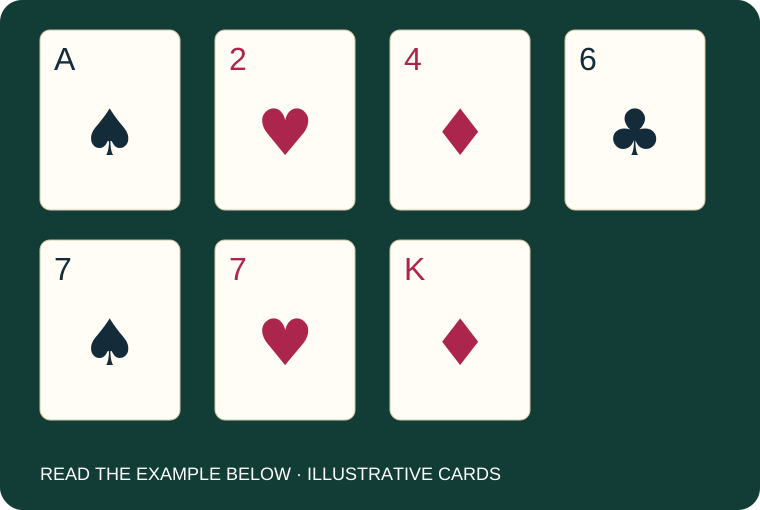
The best hand is seven-six-four-two-ace. The duplicate seven does not force a pair because five different ranks are available. It beats seven-six-five-three-ace at the third comparison, four against five. It loses to seven-five-four-three-two at the second comparison, six against five, despite containing an ace. If the deuce were instead another king, you could no longer select these same five different low ranks and would need to reassess the complete hand.
Reading a low
Prefer an unpaired hand to a paired one. Within unpaired hands, sort from highest downward and compare at the first difference. Eight-five-four-two-ace beats eight-six-three-two-ace because five beats six after the common eight.
Aces are always low. A-2-3-4-5 is the best hand even when suited. Unlike deuce-to-seven lowball, neither a straight nor a flush makes the hand worse. If everyone has a poor hand, even an unpaired king-high can win; no qualifying ceiling is imposed.
Practical procedure
The betting order can change as exposed boards develop. The player who acts first has the best visible low board, not necessarily the best complete hand. If all opponents fold, the last player wins without proving a low.
For a teaching showdown, arrange a five-card unpaired candidate first. Put duplicate ranks beside it and check whether another available card removes the pair. This separates the ranking calculation from questions about earlier betting decisions.
A full table can exhaust the deck before individual seventh cards are possible. Follow a declared stud shortage procedure, such as a shared final card, rather than giving one seat an improvised replacement.
Try comparing two lows aloud from left to right. Stop at the first different rank and name the winner before looking at the remaining cards. This exercise prevents the familiar error of preferring any hand containing an ace or treating the sum of card values as the score.
Common misunderstandings
- There is no eight-low qualification.
- The highest door card brings in.
- Suits and straights do not spoil ace-to-five low.
Agree the variant before starting
- London lowball uses different rankings.
- Razz is the R in HORSE.
Rules and further reading
Educational synthesis with AI assistance. Source check: 25 October 2026. No federation endorsement or professional review is claimed.
All card lessons · Check local rules · Understand bonus conditions · Independent support
Your next useful step
- How to play Seven-card Stud: rules and examples
Follow an individual board instead of shared community cards.
- How to play Stud Eight-or-Better: rules and examples
Compare split-pot qualification with a game of individual exposed and concealed cards.
- How to play Deuce-to-Seven Triple Draw: rules and examples
Compare a different low-hand system: aces, straights and flushes change the evaluation.
- Card learning library
Choose a clearly named rule set and practise with a physical deck without money at stake.