 CURRENT EDITION


US edition · Rules, worked cards & common mistakes
How to play Seven-card Stud: rules and examples
Learn seven-card Stud with antes, bring-ins, exposed-card action order, betting limits and an illustrated full-house comparison at showdown.
Learn with a physical deck and no money at stake. Knowing the rules does not establish legal permission to gamble.
- Players
- 2–8
- Deck
- 52 cards, no jokers
- Goal
- Make the best five-card high hand from your own seven cards.
Stud has no shared flop and no permanent button position determining who speaks first. Some cards are visible, others hidden, and the exposed boards control the betting order. This guide uses fixed-limit high-only stud. Exposed cards remain part of their owner's private hand: seeing them does not let an opponent use them.
Play a practice round, step by step
- Everyone antes. Deal two cards down and one up to each player; this is third street.
- The lowest exposed card supplies the bring-in. Break equal opening ranks by an agreed suit order for this procedural purpose only.
- Deal fourth street up and bet; repeat for fifth and sixth. Deal seventh street down and bet again.
- From fourth street onward the highest exposed board acts first, with tied boards resolved by position clockwise from the dealer.
- At showdown choose any five of your seven cards. Standard high-poker rankings decide the pot; identical five-card ranks tie.
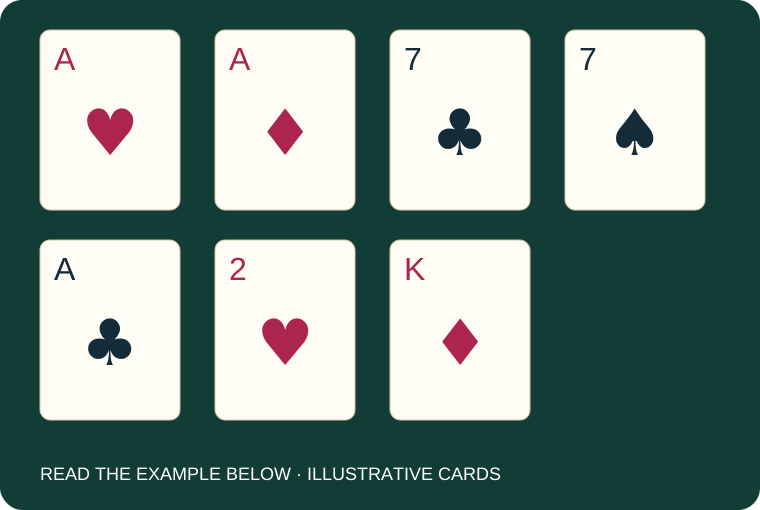
Select A♥ A♦ A♣ 7♣ 7♠. The king and two are unused. Aces full of sevens beat kings full of queens because a full house is compared by its three-card rank before its pair. For a realistic practice opponent, use K♣ K♥ K♠ Q♣ Q♦ with two irrelevant small cards. Their three kings lose to your three aces even though their pair of queens outranks your sevens. Never add the unused king from your own hand as a sixth-card tiebreaker.
Limits and an exception
Third and fourth streets use the smaller limit; fifth through seventh use the larger limit. In high-only stud an exposed pair on fourth street may permit the larger betting amount. Confirm that option before dealing instead of borrowing it automatically from another stud variant.
Check if no bet is faced, otherwise fold, call, or raise. If everyone but one player folds, the remaining player wins immediately. All-in players remain eligible only for the pots they funded; separate side pots as needed.
Card shortage and table practice
Eight players receiving seven cards would need fifty-six cards even before burns. A published shortage procedure can provide a shared final card when the deck cannot supply individual rivers. Announce the procedure before the situation occurs.
Keep upcards in dealt order. For a practice hand, note which exposed cards disappear when an opponent folds. Those cards cannot return to complete your hand. This information gives stud a different texture from a game where nearly all opponent cards remain hidden.
At showdown, write the selected five cards beneath each hand before comparing them. Four exposed hearts do not establish a flush; the hidden cards must complete it. An exposed pair may become a full house or remain only a pair. Separating what is visible from what is proved prevents premature pot awards.
Common misunderstandings
- Visible cards are not community cards.
- Bring-in suit order does not break showdown ties.
- Use the best five, not all seven.
Agree the variant before starting
- Stud eight-or-better introduces a qualifying low half.
- Razz uses low-only rankings and a different bring-in.
Rules and further reading
Educational synthesis with AI assistance. Source check: 25 October 2026. No federation endorsement or professional review is claimed.
All card lessons · Check local rules · Understand bonus conditions · Independent support
Your next useful step
- Poker hand rankings: high hands, kickers and ties
Check the standard high-hand comparison, then notice which variants deliberately depart from it.
- How to play Stud Eight-or-Better: rules and examples
Compare split-pot qualification with a game of individual exposed and concealed cards.
- How to play Razz: rules and examples
Test an ace-to-five low-hand system where a strong-looking high hand can be unhelpful.
- Card learning library
Choose a clearly named rule set and practise with a physical deck without money at stake.