 CURRENT EDITION


US edition · Rules, worked cards & common mistakes
How to play Stud Eight-or-Better: rules and examples
Learn Stud eight-or-better with high and low selection, the eight-low qualifier, betting order and an illustrated wheel that can win both halves.
Learn with a physical deck and no money at stake. Knowing the rules does not establish legal permission to gamble.
- Players
- 2–8
- Deck
- 52 cards, no jokers
- Goal
- Win high, qualifying low, or both from seven private cards.
Stud Hi/Lo eight-or-better combines exposed-card information with two separate comparisons. Unlike Omaha, all seven cards belong to you and any five may be selected for each half. The high and low selections need not be identical. This guide uses fixed-limit play and the eight-low qualifier rather than older declaration formats.
Play a practice round, step by step
- Ante, then receive two hidden cards and one exposed card. The lowest door card supplies the bring-in.
- Receive fourth, fifth, and sixth streets face up, with a betting round after each.
- Receive seventh street face down and complete the final betting round.
- From fourth street the highest exposed board acts first. Use small bets on third and fourth, large bets on fifth through seventh.
- Compare high normally, then low. Award the full pot to high if no low qualifies.
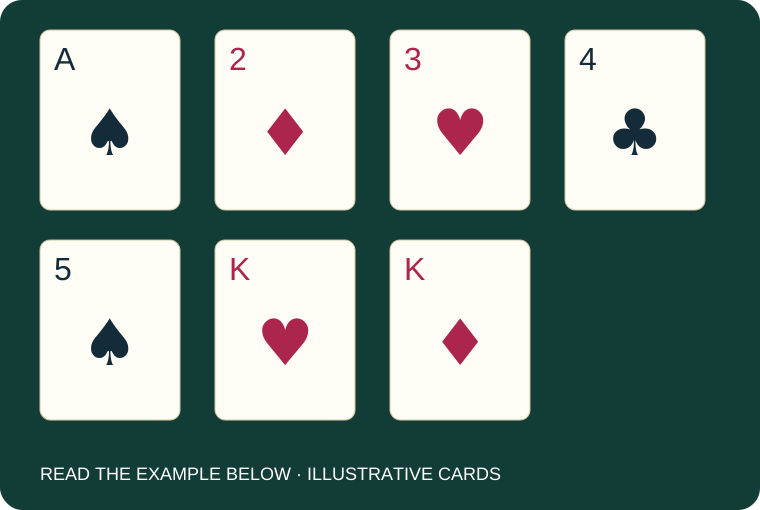
A♠ 2♦ 3♥ 4♣ 5♠ makes the best possible low and also a five-high straight. For high, that straight is stronger than the available pair of kings. Against three queens and a seven-low, the hand scoops. Against a flush with no low, it wins the low half only. Against another wheel, the low ties regardless of suits. The final pot share depends on both comparisons, not on a special automatic award for holding a wheel.
Qualification and action
A low contains five different ranks eight or below. Aces are low, and straights or flushes do not damage a low. Compare highest ranks first. Six-five-four-two-ace loses to six-four-three-two-ace when their common six is followed by five versus four.
An exposed fourth-street pair does not activate high-only stud's optional larger bet. The highest visible board still acts first after third street, even when another player's low draw looks promising. A fold ends eligibility for both halves.
Calculating a split
There is no need to declare which half you want in this baseline. A player may scoop both, win one, tie one, or fail to qualify low at all. Evaluate side pots independently and state an odd-chip convention in advance.
For a forty-eight-counter pot, a sole high winner receives twenty-four. If two other players tie low, each receives twelve. If the high winner is also among those tied lows, that player takes thirty-six overall. Lay out those counters during a practice showdown so the arithmetic is visible.
Do not infer a completed low from four attractive upcards. A board of three-four-six-seven may conceal only duplicate ranks and high cards. Conversely, a player with an ugly-looking board can hide the three ranks needed to complete a low. Show all necessary cards before the pot is divided.
Common misunderstandings
- Five small cards with a repeated rank are not a qualifying low.
- No low means high takes the whole pot.
- Do not import Omaha's two-private-card requirement.
Agree the variant before starting
- Non-qualifier and declaration high-low are separate formats.
- This game is the E in HORSE.
Rules and further reading
Educational synthesis with AI assistance. Source check: 25 October 2026. No federation endorsement or professional review is claimed.
All card lessons · Check local rules · Understand bonus conditions · Independent support
Your next useful step
- How to play Seven-card Stud: rules and examples
Follow an individual board instead of shared community cards.
- How to play Omaha Eight-or-Better: rules and examples
Add a qualifying low half to Omaha and check when a pot is not split.
- How to play Razz: rules and examples
Test an ace-to-five low-hand system where a strong-looking high hand can be unhelpful.
- Card learning library
Choose a clearly named rule set and practise with a physical deck without money at stake.