 CURRENT EDITION


US edition · Rules, worked cards & common mistakes
How to play Omaha Eight-or-Better: rules and examples
Learn Omaha eight-or-better with high and low hand construction, qualification, split-pot arithmetic and an illustrated ace-deuce showdown.
Learn with a physical deck and no money at stake. Knowing the rules does not establish legal permission to gamble.
- Players
- 2–9
- Deck
- 52 cards; four private cards each
- Goal
- Compete for high and for a qualifying low, using exactly two private cards in each hand.
Omaha eight-or-better divides a pot between two hand comparisons. A low must contain five different ranks, all eight or below. A player can win both halves, called scooping. This guide uses fixed-limit betting and no declaration of high or low: eligible hands speak for themselves at showdown. Read the complete five-card construction before assigning either half.
Play a practice round, step by step
- Post blinds and deal four private cards. Bet before the flop, beginning left of the big blind.
- Reveal the three-card flop, then turn and river individually, betting after each. Use the smaller bet before and on the flop, larger on turn and river.
- For high, choose exactly two private cards and three board cards using ordinary poker rankings.
- For low, independently choose exactly two private and three board cards, with five distinct ranks eight or below.
- Award half to high and half to the best qualifying low. Without a low, high receives everything.
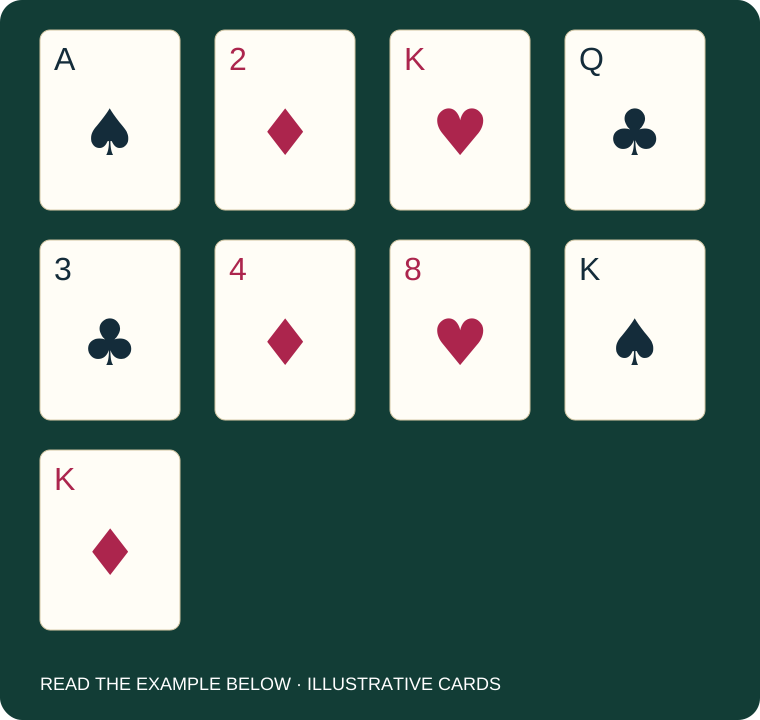
Low uses the ace and deuce with three, four, and eight: eight-four-three-two-ace, the best possible low on this board, though another ace-deuce can tie it. High uses the king and ace with both board kings and the eight: three kings, ace kicker, eight kicker. Different private pairs are legal. A full house can beat the high hand. Replace the board eight with a queen and there are only two distinct low board ranks; nobody can qualify.
Reading the low
Aces are low; straights and flushes do not spoil a low, but pairs do. Compare ranks from highest downward. Seven-six-four-two-ace beats eight-four-three-two-ace at the first comparison. A board needs at least three distinct low ranks before anyone can qualify.
Do not assume your original ace-deuce combination stays useful. If the board repeats one of those ranks, your five selected cards may contain a pair. Another private combination can sometimes replace it, but the exact two-plus-three rule never disappears.
Shares and teaching practice
Tied lows divide the low half, not the entire pot. Apply the comparison separately to side pots because not every player is eligible for every pot. Agree an odd-chip convention in advance.
With two players, the button posts the small blind and acts first before the flop, then last after it. The opponent posts the big blind. Use this heads-up exception instead of the multi-player action order.
Use a worksheet with HIGH and LOW columns. Write each player's selected five cards in both columns. Cross out any low containing a nine, a repeated rank, or an incorrect number of private cards. Divide counters only after this audit.
For a pot of eighty counters, one high winner receives forty. Two other players tied for low receive twenty each. If the high winner also ties for low, that player receives sixty in total. This exercise demonstrates why simply making a low does not guarantee half the pot or a good result.
Common misunderstandings
- Three low board cards must have distinct ranks.
- High and low may use different private pairs.
- Tying low can return only one quarter of the pot.
Agree the variant before starting
- Big O deals five private cards but still uses two.
- Pot-limit and no-limit betting versions exist.
Rules and further reading
Educational synthesis with AI assistance. Source check: 25 October 2026. No federation endorsement or professional review is claimed.
All card lessons · Check local rules · Understand bonus conditions · Independent support
Your next useful step
- How to play Omaha High: rules and examples
Compare the exact-two-private-card requirement with unrestricted best-five selection in Hold’em.
- How to play Stud Eight-or-Better: rules and examples
Compare split-pot qualification with a game of individual exposed and concealed cards.
- How to play Razz: rules and examples
Test an ace-to-five low-hand system where a strong-looking high hand can be unhelpful.
- Card learning library
Choose a clearly named rule set and practise with a physical deck without money at stake.