 CURRENT EDITION


US edition · Rules, worked cards & common mistakes
How to play Omaha High: rules and examples
Learn pot-limit Omaha with the exact two-private-card rule, betting arithmetic, board traps and an illustrated hand that explains flushes.
Learn with a physical deck and no money at stake. Knowing the rules does not establish legal permission to gamble.
- Players
- 2–9
- Deck
- 52 cards, four private cards per player
- Goal
- Build the strongest hand using exactly two private cards and exactly three board cards.
Omaha looks like Hold’em but changes the construction rule that decides every showdown. Four hole cards create six possible pairs to combine with the board, not a nine-card collection from which anything goes. This guide uses pot-limit Omaha, often shortened to PLO. It is high-only: low cards do not receive a separate portion of the pot.
Play a practice round, step by step
- Post small and big blinds beside the moving button. Deal four private cards each, then complete the first betting round.
- Reveal a three-card flop, a one-card turn, and a one-card river, with a betting round after each and normal burn-card practice.
- Act left of the big blind before the flop and left of the button afterward, skipping folded players.
- At every hand comparison select exactly two of your four private cards and three of the five board cards.
- Pay the best ordinary high-poker hand, split complete ties, or award the pot immediately when only one player remains.
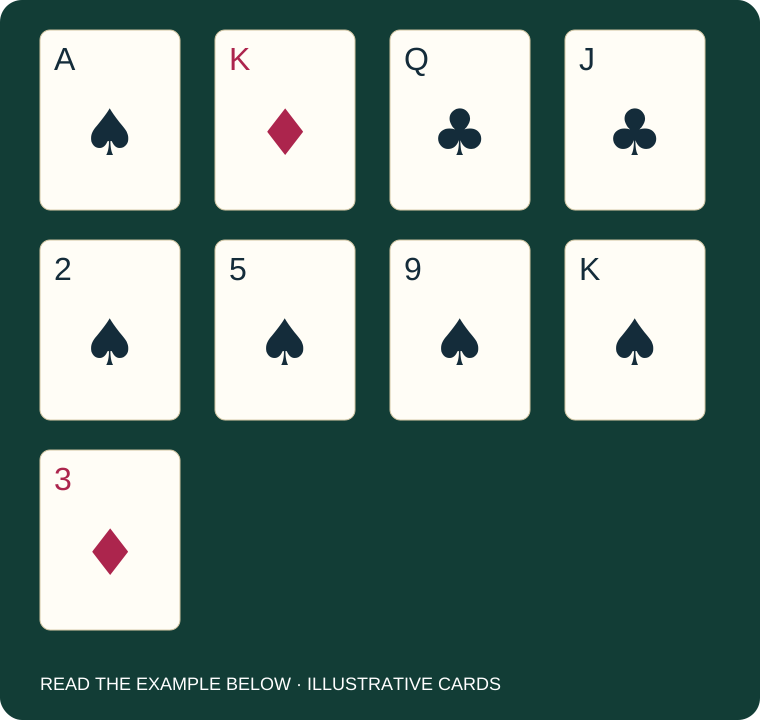
There are four spades on the board and an ace of spades in the hand, but this player has no flush: only one private spade is available. Selecting K♦ and A♠ with K♠, 9♠, and 5♠ gives a pair of kings with ace, nine, and five kickers. A player holding two spades could construct a flush using three board spades and would beat that pair. The conspicuous ace is useful, but it does not override the selection rule.
Pot-limit arithmetic
A maximum raise is the size of the pot after you first call. Suppose the pot was forty and a player bets ten. You face ten with fifty now in the middle: call ten, making sixty, then raise by up to sixty. Your maximum total contribution for that action is seventy.
Keep the call and the raise conceptually separate even if you announce one total amount. The minimum ordinary raise follows the last full raise increment. All-in players contest only pots they have funded; side pots do not change the two-plus-three construction rule.
Heads-up exception: the button posts the small blind and acts first before the flop, then last after the flop. The other player posts the big blind. This overrides the multi-player seat descriptions in the deal sequence.
Board traps and ranking
Use standard high rankings: straight flush, quads, full house, flush, straight, trips, two pair, pair, high card. Ties compare only the selected five cards. A lone ace of a suit cannot make a flush with four suited board cards. Likewise a board straight cannot simply be played by everyone.
A practical teaching exercise is to spread your four hole cards into all six possible pairs. For each pair, search for the best compatible three-card board selection. You do not need to repeat this physically forever, but doing it slowly once exposes why attractive Hold’em-style readings fail.
Finish a practice session by replaying disputed showdowns with all cards visible. Write the selected five cards down for each player. If either list contains one or three private cards, correct the construction before comparing ranks or discussing who would have won.
Common misunderstandings
- Four private cards do not mean four cards may play.
- A board flush does not automatically give you a flush.
- Pot-limit is not the same as no-limit.
Agree the variant before starting
- Five-card and six-card Omaha still require exactly two private cards.
- Omaha eight-or-better adds a qualifying low half.
Rules and further reading
Educational synthesis with AI assistance. Source check: 25 October 2026. No federation endorsement or professional review is claimed.
All card lessons · Check local rules · Understand bonus conditions · Independent support
Your next useful step
- How to play Texas Hold’em: rules and examples
See how a shared board combines with two private cards and best-five selection.
- How to play Omaha Eight-or-Better: rules and examples
Add a qualifying low half to Omaha and check when a pot is not split.
- Poker hand rankings: high hands, kickers and ties
Check the standard high-hand comparison, then notice which variants deliberately depart from it.
- Card learning library
Choose a clearly named rule set and practise with a physical deck without money at stake.