 CURRENT EDITION


US edition · Rules, worked cards & common mistakes
How to play Texas Hold’em: rules and examples
Learn Texas Hold’em blinds, betting streets, hand rankings and showdown ties with an illustrated seven-card example and heads-up exceptions.
Learn with a physical deck and no money at stake. Knowing the rules does not establish legal permission to gamble.
- Players
- 2–10
- Deck
- 52 cards, no jokers
- Goal
- Win the pot by making the best five-card hand or having every opponent fold.
Texas Hold’em combines two private cards with five shared board cards. This guide uses no-limit betting and play counters. The fundamental skill for a beginner is identifying the actual five-card hand: your two private cards are available, but neither is compulsory. A dramatic-looking private pair can become irrelevant when the board supplies everyone’s best hand.
Play a practice round, step by step
- Move the dealer button each hand. The next two players post small and big blinds; deal two private cards each.
- Bet before the flop, starting left of the big blind. Players may fold, call the amount faced, or raise within their stack. A player facing no bet may check.
- Burn a card and reveal three board cards, the flop. Bet starting with the first active player left of the button.
- Burn and reveal the turn, bet, then burn and reveal the river and bet again.
- If multiple players remain, compare their best five cards from the seven available. Split exactly tied hands; suits never break a poker tie.
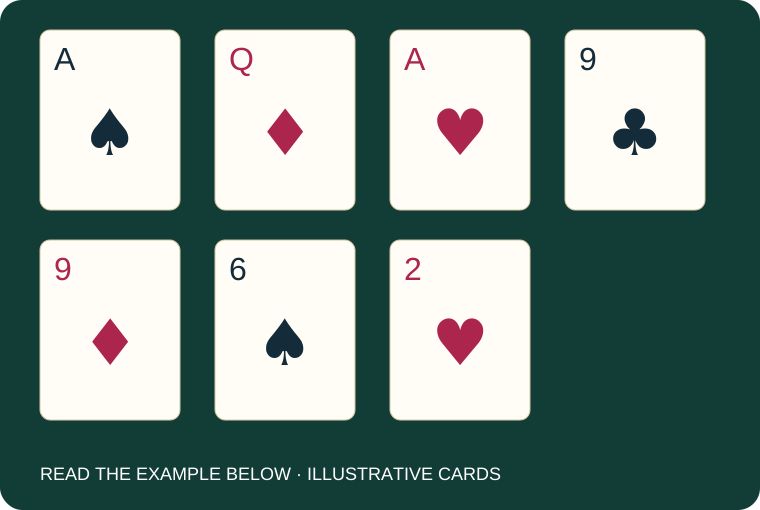
The best hand is aces and nines with a queen kicker: A-A-9-9-Q. An opponent holding A♣ J♣ also has aces and nines, but loses because the jack kicker is lower. An opponent holding 9♠ 8♠ instead has three nines and wins. Now replace the board’s two with a king: both ace-queen and ace-jack use the board king as kicker and tie. The unused queen and jack cannot become a sixth-card tiebreaker.
Ranks and betting limits
From strongest to weakest: straight flush, four of a kind, full house, flush, straight, three of a kind, two pair, pair, high card. Compare the relevant ranks, then remaining kickers. An ace can finish A-2-3-4-5 or 10-J-Q-K-A, but cannot wrap around K-A-2.
No-limit means any amount up to your remaining stack, subject to minimum-bet and minimum-raise rules. An ordinary raise must at least match the preceding full raise increment. A short all-in may not reopen raising. Keep unmatched excess out of the pot; separate side pots when different stack sizes go all-in.
Round end and heads-up play
If everyone except one player folds, that player wins without needing to display a stronger hand. At showdown, reveal enough cards to prove the whole hand, not just the pair you want to announce. A tournament continues until the agreed finishing condition; a social session can end after a fixed number of deals.
With two players, the button posts the small blind and acts first before the flop, but last after it. Place a button marker physically on the table while learning. It prevents the common mistake of treating the person shuffling as the player who must act last on every street.
Common misunderstandings
- You may use zero, one, or two private cards.
- Compare exactly five cards, never six or seven.
- Calling a bet is different from checking.
Agree the variant before starting
- Fixed-limit and pot-limit Hold’em use the same card construction with different betting ceilings.
- Tournament blind schedules are an additional agreement.
Rules and further reading
Educational synthesis with AI assistance. Source check: 25 October 2026. No federation endorsement or professional review is claimed.
All card lessons · Check local rules · Understand bonus conditions · Independent support
Your next useful step
- Poker hand rankings: high hands, kickers and ties
Check the standard high-hand comparison, then notice which variants deliberately depart from it.
- How to play Omaha High: rules and examples
Compare the exact-two-private-card requirement with unrestricted best-five selection in Hold’em.
- How to play Short-deck Hold’em: rules and examples
Check how removing low ranks changes the deck and the agreed hand order.
- Card learning library
Choose a clearly named rule set and practise with a physical deck without money at stake.