 CURRENT EDITION


US edition · Rules, worked cards & common mistakes
How to play Short-deck Hold’em: rules and examples
Learn short-deck Hold’em with a clear 36-card baseline, button-blind setup, revised hand rankings and an illustrated ace-low straight example.
Learn with a physical deck and no money at stake. Knowing the rules does not establish legal permission to gamble.
- Players
- 2–6
- Deck
- 36 cards: six through ace
- Goal
- Build the best five-card hand in a 36-card Hold’em game with revised rankings.
Short-deck, often called six-plus Hold'em, removes twos through fives and changes the value of some familiar combinations. There is no single universal short-deck ruleset. This guide adopts the named six-plus baseline in the sources: a flush beats a full house, a straight still beats three of a kind, and everyone antes with a single button blind.
Play a practice round, step by step
- Prepare the thirty-six cards from six through ace. Everyone posts the ante; the button posts the additional button blind.
- Deal two private cards each. Begin preflop action with the first player left of the button.
- Burn and reveal the three-card flop. Bet, then burn and reveal turn and river individually with betting rounds.
- Build any five-card hand from your two private and five board cards, using zero, one, or two private cards.
- Resolve the pot with the stated short-deck rankings. Move the button and repeat, or stop at the agreed practice-session end.
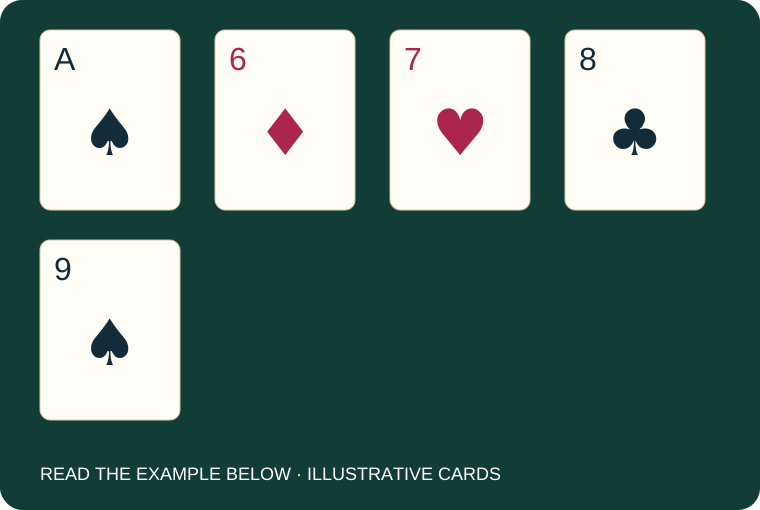
These five cards form a nine-high straight under the baseline described here. The ace takes the low role normally occupied by a five in a full-deck sequence. A hand of 6-7-8-9-10 beats it as a ten-high straight. Three kings lose to either straight in this version, while a flush beats a full house. If your group instead chooses a trips-over-straights version, this exact comparison changes; the illustration cannot settle a disagreement until the table's ranking rule has been identified.
Revised rankings
The order is straight flush, four of a kind, flush, full house, straight, three of a kind, two pair, pair, high card. The important reversal is flush above full house. Suits still do not break a tie, and only five cards count.
An ace can complete A-6-7-8-9 as the lowest straight or 10-J-Q-K-A as the highest. It does not permit an arbitrary wraparound sequence. The nine-high short-deck wheel loses to a ten-high straight.
Action and local differences
In the button-blind structure, action starts left of the button before the flop, as well as after it. Use the declared no-limit minimum-raise rules; an ante is not itself a live call toward the blind. Side pots and all-in eligibility work as in ordinary poker.
Some short-deck tables rank trips above straights or use two blinds. Those changes are substantial. Write the complete ranking order and forced-payment structure on a card before a first session; merely saying 'short deck' is insufficient.
Do a physical deck audit before shuffling. There should be nine ranks in each of four suits. A stray deuce is not just cosmetic: it creates a hand outside the selected game. Check examples against the reduced deck too.
For teaching, compare one flush against one full house and one straight against one set before playing. Ask each player to explain both results. This brief exercise exposes the two different assumptions visitors most often bring from other poker games.
Common misunderstandings
- Do not use ordinary full-house-over-flush ranking.
- Confirm whether trips or straights rank higher.
- A-6-7-8-9 is valid; arbitrary ace wraparounds are not.
Agree the variant before starting
- Trips-over-straights and two-blind formats must be named separately.
- This guide follows the cited six-plus ranking baseline.
Rules and further reading
Educational synthesis with AI assistance. Source check: 25 October 2026. No federation endorsement or professional review is claimed.
All card lessons · Check local rules · Understand bonus conditions · Independent support
Your next useful step
- How to play Texas Hold’em: rules and examples
See how a shared board combines with two private cards and best-five selection.
- Poker hand rankings: high hands, kickers and ties
Check the standard high-hand comparison, then notice which variants deliberately depart from it.
- How to play Omaha High: rules and examples
Compare the exact-two-private-card requirement with unrestricted best-five selection in Hold’em.
- Card learning library
Choose a clearly named rule set and practise with a physical deck without money at stake.