 CURRENT EDITION


US edition · Rules, worked cards & common mistakes
How to play Badugi: rules and examples
Learn Badugi with three draws, suit and rank restrictions, usable-card comparisons and an illustrated hand explaining why four suits may fail.
Learn with a physical deck and no money at stake. Knowing the rules does not establish legal permission to gamble.
- Players
- 2–6
- Deck
- 52 cards; four private cards each
- Goal
- Make the lowest four-card hand with four different ranks and four different suits.
Badugi is a draw-poker game with its own hand evaluation. Four different suits are helpful rather than harmful, and a four-card qualifying hand always beats a three-card hand. The number of usable cards comes before how low they are. This guide uses the usual three draws and fixed-limit betting, with aces low and no straight penalty.
Play a practice round, step by step
- Place a moving dealer button and small and big blinds. Deal four cards face down to each player.
- Complete the first betting round starting left of the big blind.
- Starting left of the button, each active player exchanges any number of cards, including zero. Bet after the draw.
- Repeat twice more, producing three draws and four betting rounds. Use small bets for the first two rounds and larger bets for the final two.
- At showdown choose the largest subset with no repeated rank or suit. Compare equal-sized subsets from highest rank downward, lower winning.
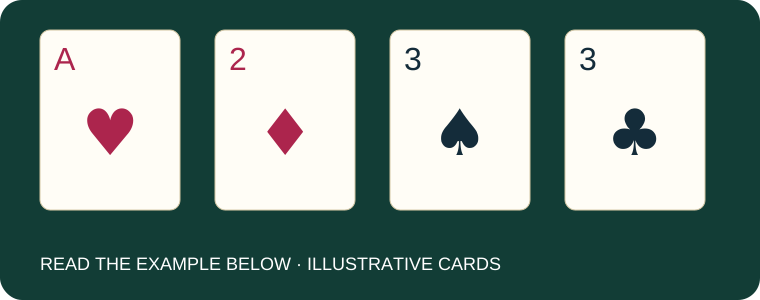
Although all four suits are present, the two threes share a rank. The best subset is A♥ 2♦ and either three, a three-card three. Every full badugi defeats it, even K-Q-J-10 with four different suits. Replacing 3♣ with 4♣ creates A-2-3-4 in four suits, the best badugi. Replacing it with 4♥ would still leave a suit conflict with the ace, so the hand would not become a badugi simply because the repeated rank disappeared. Check rank and suit separately.
How a hand is reduced
Four usable cards make a badugi. Every badugi beats every three-card hand; any three-card hand beats any two-card hand. When ranks or suits conflict, retain the combination with the most usable cards, then the lowest ranking within that size. Do not simply discard the numerically highest card without checking the remaining suit conflicts.
Aces are low and sequences do not count against you. A-2-3-4 in four different suits is the strongest possible badugi. Exact rank ties split; the particular allocation of suits cannot break them.
Drawing and finishing
Standing pat means drawing zero. You may stand pat on one draw and exchange later. Keep discards clearly separate and use an agreed deck-shortage procedure if replacement cards run out. If everyone except one player folds, award the pot without comparing hands.
For practice, make four columns labelled spades, hearts, diamonds, and clubs. Place the hand into the columns and look for suit duplicates. Then check the selected cards for rank duplicates. Both tests matter: one card from each suit can still contain a pair.
A useful exercise is to compare a king-high badugi with a three-card three. The king-high hand wins because four usable cards outrank three. Next compare two four-card hands with the same highest rank. Read down until a difference appears, exactly as with other lowball comparisons.
Keep the actual four dealt cards visible at showdown, even when only two or three count. The excluded cards explain the classification and allow opponents to verify that a better legal subset was not overlooked.
Two-player exception
With two players, the button posts the small blind and acts first in the opening betting round. The opponent posts the big blind, draws first, and acts first in betting after each draw. This replaces the multi-player seat order described above.
Common misunderstandings
- Four suits alone are insufficient if a rank repeats.
- A four-card badugi outranks every three-card hand.
- Aces are low, and straights do not count.
Agree the variant before starting
- Pot-limit betting exists, with the same hand ranking.
- Badacey and Badeucy are split-pot mixed variants, not synonyms for Badugi.
Rules and further reading
Educational synthesis with AI assistance. Source check: 25 October 2026. No federation endorsement or professional review is claimed.
All card lessons · Check local rules · Understand bonus conditions · Independent support
Your next useful step
- How to play Deuce-to-Seven Triple Draw: rules and examples
Compare a different low-hand system: aces, straights and flushes change the evaluation.
- How to play Five-card Draw: rules and examples
Learn replacement draws while keeping the completed hand private.
- Poker hand rankings: high hands, kickers and ties
Check the standard high-hand comparison, then notice which variants deliberately depart from it.
- Card learning library
Choose a clearly named rule set and practise with a physical deck without money at stake.