 CURRENT EDITION


US edition · Rules, worked cards & common mistakes
How to play Hearts: rules and examples
Learn Hearts with passing, following suit, heart-breaking rules and penalty scoring, plus an illustrated trick and a clear shooting-the-moon baseline.
Learn with a physical deck and no money at stake. Knowing the rules does not establish legal permission to gamble.
- Players
- 4
- Deck
- 52 cards; no jokers
- Goal
- Finish with the fewest penalty points.
Hearts rewards careful attention to what a trick contains, rather than simply winning it. This lesson chooses a four-player American passing game, with hearts broken only by a discarded heart. It is an individual contest: temporary cooperation does not create permanent partners. Play the first deal with cards visible if everyone agrees, then repeat with normal hidden hands.
Play a practice round, step by step
- Deal thirteen cards each. Before play, pass three cards left on the first deal, right on the second, across on the third, and none on the fourth; repeat that cycle. Select your outgoing cards before collecting incoming ones.
- The holder of the club two leads it. Follow the led suit whenever possible; otherwise discard. On the first trick, do not discard a heart or spade queen unless your remaining hand offers no permitted alternative.
- The highest card in the led suit wins. There are no trumps. The winner gathers the trick and leads the next one.
- Do not lead a heart until someone has discarded a heart on a previous trick, unless your hand contains only hearts. In this chosen version the spade queen alone does not break hearts.
- After thirteen tricks, count one penalty for every heart and thirteen for the spade queen. Continue until someone reaches at least 100; the lowest total wins.
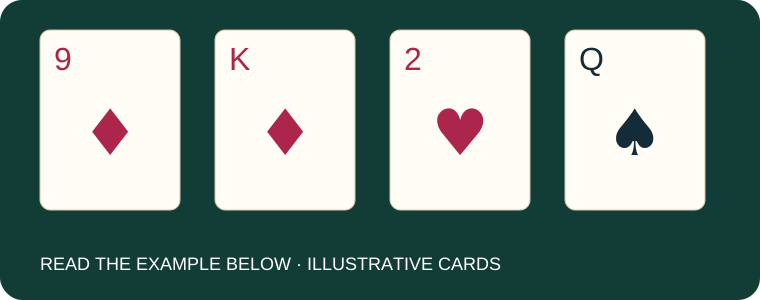
Imagine this is a later trick: the diamond nine is led, followed by the diamond king, heart two and spade queen. The last two players have no diamonds. The king wins because it is the higher diamond; the queen does not trump anything. That one trick costs fourteen penalties: one for the heart and thirteen for the queen. Change only the queen to the spade ace and the same winner receives just one penalty. The winner and the score are separate calculations.
The unusual all-penalties result
A player collecting all thirteen hearts and the spade queen has shot the moon. For this teaching game, give that player zero and each opponent twenty-six. Do not award the moon merely for winning every heart while another player holds the queen. Some tables offer a subtraction option instead; choose that convention before dealing.
Normal hand penalties add to twenty-six. Use that arithmetic as a checking tool, not a substitute for inspecting the cards. A score sheet with totals 4, 6, 3 and 13 accounts for all penalties. A total of twenty-five means something has been missed or recorded incorrectly. Pause and recount while the tricks are still separate.
A practice exercise
Place four empty spaces in a row to represent one trick. Announce the led suit before placing the other cards. After deciding who wins, move any penalty cards to a separate visible pile. This separates two questions that beginners often merge: who owns the trick, and how costly is it? Repeat the exercise with exactly the same ranks but a different first card.
For passing practice, write down which direction applies before looking at your hand. Deal four practice hands without playing them, cycling through the directions. This small rehearsal prevents a perfectly legal selection of three cards from being delivered to the wrong person. In normal play, do not reveal the cards you passed to someone else.
Common misunderstandings
- A spade is not trump in Hearts.
- Do not confuse the deal passing cycle with the direction of play.
- Taking many harmless tricks does not itself add penalties.
Agree the variant before starting
- Some rule sets allow the spade queen to break hearts; this page does not.
- Other moon scoring and first-trick exceptions require an agreement.
Rules and further reading
Educational synthesis with AI assistance. Source check: 25 October 2026. No federation endorsement or professional review is claimed.
All card lessons · Check local rules · Understand bonus conditions · Independent support
Your next useful step
- How to play Partnership Spades: rules and examples
Compare a fixed trump suit and a partnership trick-count promise.
- How to play Contract Bridge: rules and examples
Separate the contract auction, dummy and play of the cards.
- How to play Euchre: rules and examples
See how the two bowers change both trump ranking and following suit.
- Card learning library
Choose a clearly named rule set and practise with a physical deck without money at stake.