 CURRENT EDITION

US edition · Rules, worked cards & common mistakes
How to play Partnership Spades: rules and examples
Learn partnership Spades with bids, trump tricks, nil contracts and bag penalties, plus an illustrated trick and a complete worked scoring example.
Learn with a physical deck and no money at stake. Knowing the rules does not establish legal permission to gamble.
- Players
- 4 in two partnerships
- Deck
- 52 cards; no jokers
- Goal
- Meet the partnership bid while controlling overtricks.
Spades combines a prediction with a partnership trick-taking game. Partners sit opposite and share the result of their bids. This lesson uses ordinary ace-high cards, permanent spade trumps, nil bids and cumulative bag penalties. It excludes jokers, blind nil and special deuce rankings, so an unfamiliar house rule does not silently change the deck.
Play a practice round, step by step
- Deal thirteen cards to each player. Starting left of the dealer, everyone states a whole-number trick bid, including zero for nil. Partners add their positive bids to form the team contract.
- The player left of the dealer leads. Follow suit if you can. If you cannot, play any card, including a spade. A trump beats every card outside the trump suit.
- The highest spade wins a trick containing spades. Without a spade, the highest card of the led suit wins. The winner leads next.
- Do not lead spades until a spade has been played on another suit, unless you have only spades. This convention prevents an early trump lead; it does not prevent a legal trump discard.
- After thirteen tricks, score both partnerships, keep the bag count, and move the deal clockwise. Play complete hands until a team has reached 500, with the higher total winning if both cross the target together.
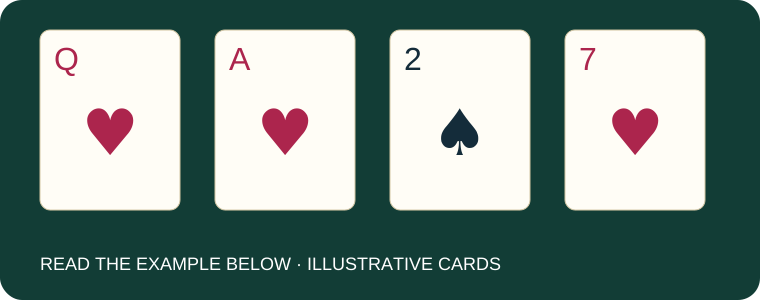
Hearts are led and the second player follows with the ace. The third player has no hearts and uses the spade two; the fourth follows with the heart seven. The two wins because spades are trump. For a separate scoring example, a partnership bidding six and taking eight earns sixty-two and adds two bags. If it already had nine bags, the total becomes eleven: deduct one hundred and carry one bag, making this hand’s net score minus thirty-eight. Taking only five would instead miss the six-trick contract and score minus sixty.
Contracts, bags and nil
Making a positive contract earns ten points per bid trick plus one per extra trick. Falling short loses ten per bid trick. Each extra trick is also a bag; every accumulated ten bags costs one hundred points, leaving any remainder for future deals. Nil succeeds only if that individual takes no tricks: award one hundred, or deduct one hundred for failure.
In this chosen nil convention, a failed nil player’s tricks do not rescue the partner’s positive bid; they count as bags. Keep the nil result and the ordinary contract on separate score-sheet lines before combining them. Other implementations handle those tricks differently, which is why the agreement matters as much as remembering a bonus number.
Rehearse the score before playing
Write a team bid beside an empty row of thirteen boxes. Mark one box for each trick the team takes. First compare the count with the bid; only then calculate overtricks. This makes a missed contract visible before anyone starts adding bag points. Give each team its own bag total rather than treating bags as a shared table penalty.
Now change the exercise without changing the cards: imagine one partner announced nil. Keep that player’s trick pile physically separate. Ask whether the nil succeeded before considering what happened to the other partner. A team can have a successful ordinary contract and a failed nil on the same hand, so the score should preserve both facts.
Common misunderstandings
- Following suit is compulsory even when a trump would win.
- Bags persist across deals; do not reset them after each hand.
- Nil means zero tricks for that player, not zero team tricks.
Agree the variant before starting
- Agree nil and failed-nil scoring before play.
- Jokers, blind bids and two-player Spades need separate rules.
Rules and further reading
Educational synthesis with AI assistance. Source check: 25 October 2026. No federation endorsement or professional review is claimed.
All card lessons · Check local rules · Understand bonus conditions · Independent support
Your next useful step
- How to play Hearts: rules and examples
Contrast winning tricks with avoiding the penalty cards contained in them.
- How to play Contract Bridge: rules and examples
Separate the contract auction, dummy and play of the cards.
- How to play Euchre: rules and examples
See how the two bowers change both trump ranking and following suit.
- Card learning library
Choose a clearly named rule set and practise with a physical deck without money at stake.