 CURRENT EDITION


US guide · Safety & player rights
Gambling blocks and self-exclusion: building several barriers
Account, device, payment, and marketing controls address different routes into gambling. A useful stopping plan checks what each barrier covers and what remains outstanding.
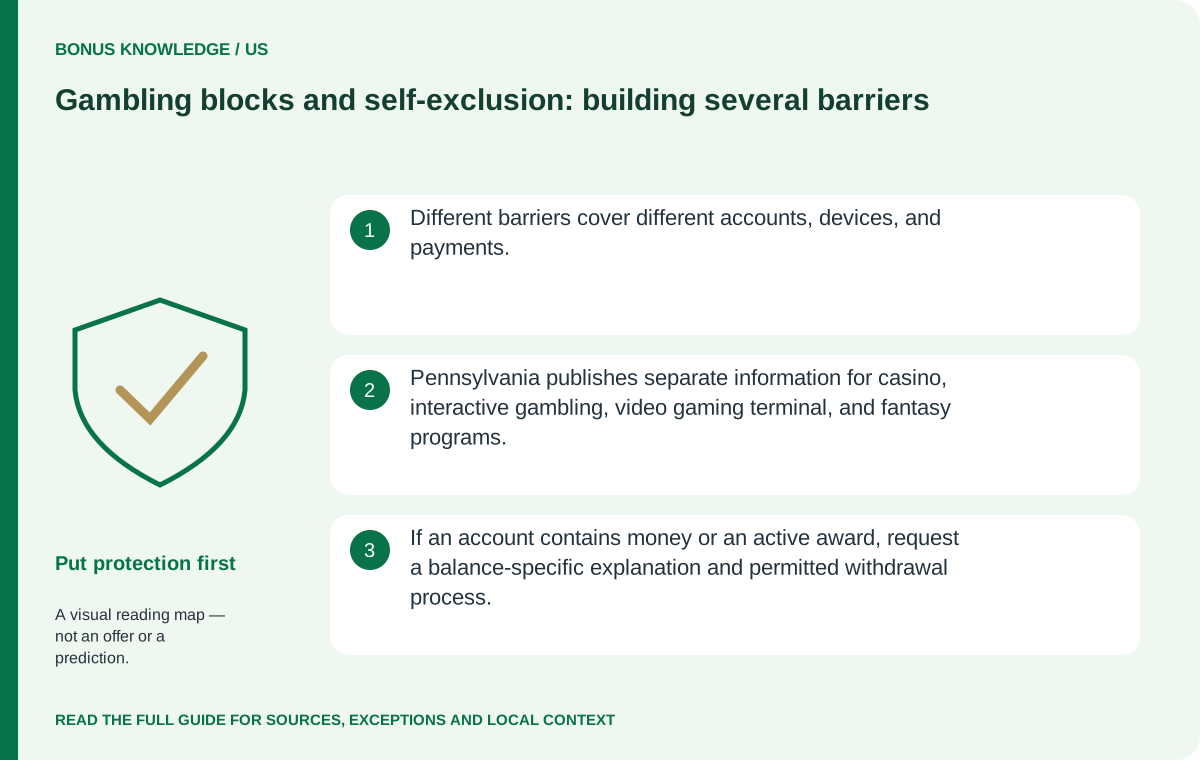
- Different barriers cover different accounts, devices, and payments.
- US self-exclusion is not one automatic nationwide system.
- Check confirmation and scope without testing by gambling.
Choose barriers by the access they interrupt
An account break pauses a particular relationship. Formal self-exclusion restricts participation within a defined program. Device blocking addresses websites or applications. Payment controls address certain transactions. Marketing opt-outs reduce prompts. None should be described as covering every possible route without evidence.
Make a private list of relevant accounts, devices, payment methods, and venues. Include a phone browser as well as installed apps and any second device regularly used. The list is for closing gaps, not finding another place to gamble. A trusted support person can help without receiving your passwords.
Read the program's actual scope
Use official state regulator or operator instructions. Pennsylvania publishes separate information for casino, interactive gambling, video gaming terminal, and fantasy programs. Other states and operators have different structures, and some restrictions extend through corporate relationships. Do not assume universal coverage or complete separation.
Identify duration, effective date, covered activities, extension and removal rules, and consequences of participating while excluded. Keep the confirmation. A promotional email or accessible login does not override an exclusion. Do not place a wager to test whether the system works.
Ask about funds without postponing the boundary
If an account contains money or an active award, request a balance-specific explanation and permitted withdrawal process. State clearly that you want to stop and do not want retention promotions. Ask for written confirmation of the restriction.
Do not continue gambling to clear a bonus before excluding. If a balance is disputed, record the amount and pursue the appropriate complaint route separately. The purpose of the restriction is to stop access, not create one final gambling task.
Check device and payment tools
Device restrictions or gambling-blocking software may interrupt habitual access. Ask about supported operating systems, relevant devices, privacy, cost, and how changes are controlled. No tool is a guarantee, and this guide does not endorse a particular commercial product.
Contact the bank or payment provider through its official channel about available controls. Ask whether they apply to debit cards, credit cards, transfers, digital wallets, cash withdrawals, or only recognized merchant categories. Ask how activation and removal work. Features vary by provider and account, so a control on one route should not be assumed to cover others.
Reduce prompts and track unfinished steps
Unsubscribe from marketing, disable notifications, and ask accounts to suppress promotional contact. If messages continue after exclusion, save them and report them through the operator or regulator process. A personalized offer is not an exception to the restriction.
Keep a record of which barriers are requested, confirmed, and awaiting action. Review gaps with a professional or trusted person through conversation and confirmation records, not attempted gambling. Practical barriers can support treatment or peer support but are not a substitute for care when more help is needed. If urges remain strong, make support contact rather than repeatedly checking the blocked account.
Worked example · hypothetical
Hypothetical example
A fictional plan lists operator exclusion confirmed, state enrollment awaiting confirmation, phone blocking configured, and a bank inquiry pending. The pending items remain visible; a card control is not assumed to block every transfer.
Common questions
Does one US self-exclusion cover every casino nationwide?
No blanket assumption is safe. Read the current program scope, including products, states, and operator-wide extensions.
How can I check a block is active?
Use settings, confirmation messages, and official support. Do not attempt to gamble or seek a workaround as a test.
Your next useful step
- Find a support contact
Choose a contact route, check its coverage, and ask about suitable local help.
- How to stop gambling: practical first steps in the US
Start with one manageable action without needing to finish a promotion.
- Helping someone affected by gambling while protecting your boundaries
Find guidance for supporting someone close while keeping your own boundaries.
- First-step support guide
Read the contact options and practical first-step plan together.
Sources & further reading
Read the source alongside the explanation. Rules and published terms can change; check the current official position where you live.
How we research and maintain guides →How this topic changes across borders
These links open the relevant local explanation. Where there is no direct equivalent, they lead to that region’s topic library.
UKGambling blocks and self-exclusion: what each tool covers →EUGambling blocks and self-exclusion: build several barriers →