 CURRENT EDITION


US guide · Safety & player rights
How to stop gambling: practical first steps in the US
Stopping can begin with one action today. You do not need a diagnosis, a particular amount of debt, or a completed bonus to ask for help.
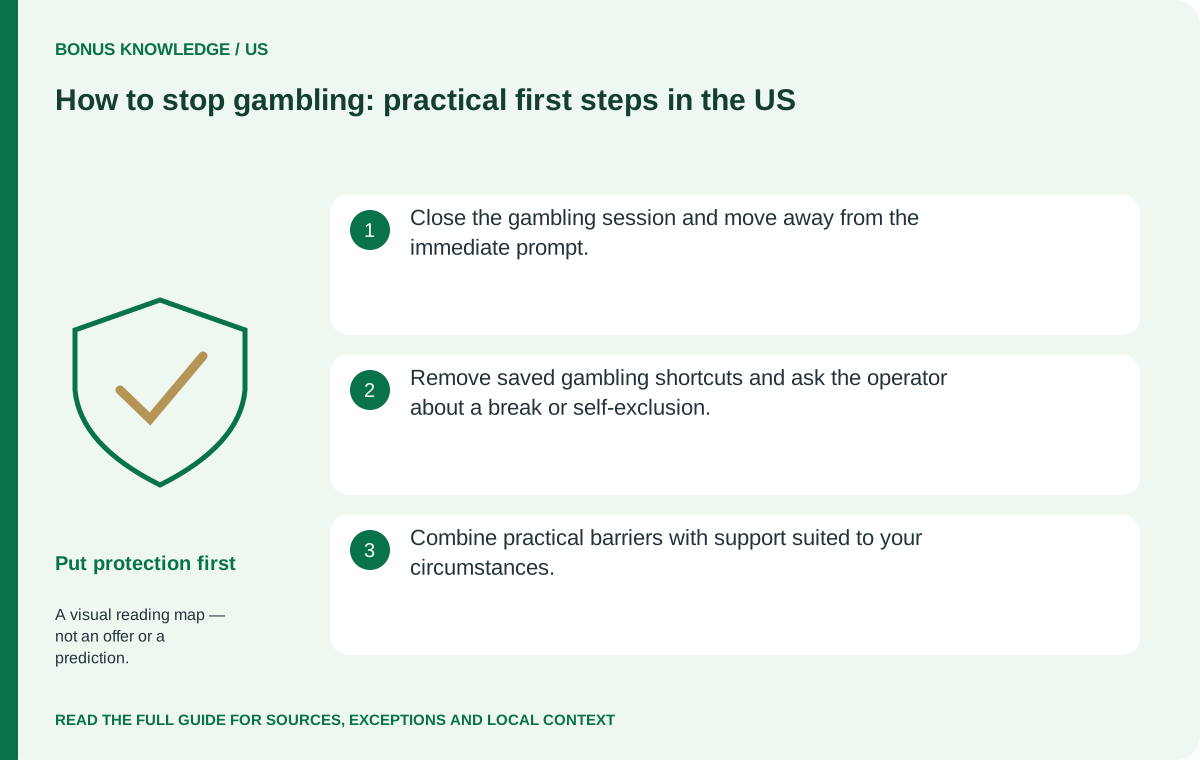
- You do not need a financial crisis to seek help.
- Stopping can begin before account questions are resolved.
- Combine practical barriers with support suited to your circumstances.
Start with the next action
Close the gambling session and move away from the immediate prompt. Put the device down, leave the venue, or spend time somewhere gambling is less accessible. Choose one manageable action rather than trying to solve every financial and emotional consequence at once.
You do not have to complete a bonus, recover a loss, or reach a round balance first. Those conditions can keep the session open. If money remains in an account, ask official support how to request a withdrawal or close the account without further wagers. Save the request and avoid cancelling a pending withdrawal to resume play.
Reduce access and protect essentials
Turn off promotional emails, texts, and push notifications. Remove saved gambling shortcuts and ask the operator about a break or self-exclusion. Deleting an app alone may leave browser access, other accounts, and marketing channels unchanged. The separate blocks guide explains how to check these gaps.
Write down immediate essentials such as housing, food, utilities, transport, and medication before discretionary spending. Ask your bank whether it offers gambling-payment controls, transaction alerts, or other safeguards. Availability and coverage vary; ask which payment routes are included. Do not assume a card control covers bank transfers, cash, or every intermediary.
Contact someone outside the platform
A useful first sentence is: 'I want to stop gambling, but I am finding it hard, and I need help with my next steps.' You can say this to a trusted person, healthcare professional, or specialist support service. You need not calculate your entire lifetime loss before making contact.
NCPG currently lists call and text access at 1-800-MY-RESET, numerically 1-800-697-3738, plus online chat and local-resource links. A helpline conversation, peer meeting, and professional treatment are different options; ask what each can provide and what costs or eligibility conditions apply.
Plan for the time gambling usually occupies
Identify concrete triggers: being alone after work, payday messages, sports broadcasts, stress, boredom, or a particular app. Plan a replacement action for the next likely trigger, such as calling someone, taking a walk, attending a meeting, or doing something away from the device. This makes the next decision easier without promising that urges disappear.
Write a response for a difficult moment: 'I will delay acting, leave the gambling screen, and contact this person or service.' Keep contact details outside gambling websites. Avoid beginning the plan by reopening an account to inspect a promotion.
Arrange follow-up and respond to setbacks
Ask a qualified professional about assessment and treatment if gambling affects sleep, relationships, work, money, or control. Massachusetts public-health guidance describes psychological treatment approaches, including cognitive behavioral therapy; selecting suitable care requires an individual discussion rather than an online diagnosis.
If gambling happens again, stop the session, tell your support contact, and review which barrier was missing or bypassed. A setback does not require a final attempt to recover money. If anyone is in immediate danger or cannot stay safe, contact local emergency services. This page provides education, not treatment or emergency care.
Worked example · hypothetical
Hypothetical example
A fictional reader usually deposits after late-night promotional texts. Their first-day plan is to mute the texts, request account exclusion, ask the bank about available controls, and arrange a support call before the usual evening gambling period.
Common questions
What if I cannot stop after deciding to?
Seek more support and strengthen barriers. Difficulty stopping is not a reason to chase losses; a specialist can help assess appropriate next steps.
Should I repay every debt before asking for help?
No. Financial organization and gambling support can be addressed alongside each other without further wagering.
Your next useful step
- Find a support contact
Choose a contact route, check its coverage, and ask about suitable local help.
- Gambling blocks and self-exclusion: building several barriers
Understand what access restrictions cover and where they leave gaps.
- Helping someone affected by gambling while protecting your boundaries
Find guidance for supporting someone close while keeping your own boundaries.
- First-step support guide
Read the contact options and practical first-step plan together.
Sources & further reading
Read the source alongside the explanation. Rules and published terms can change; check the current official position where you live.
- NCPG: Help and treatment
- Massachusetts: Treatment recommendations for gambling disorders
- Pennsylvania DDAP: Problem Gambling Services
How this topic changes across borders
These links open the relevant local explanation. Where there is no direct equivalent, they lead to that region’s topic library.
UKHow to stop gambling: practical first steps and support →EUHow to stop gambling: practical first steps for today →