 CURRENT EDITION


US guide · Safety & player rights
Helping someone affected by gambling while protecting your boundaries
You can offer meaningful support without financing gambling or taking responsibility for another adult's recovery. Your own safety and wellbeing also matter.
- Describe observed effects rather than assigning a diagnosis.
- Practical help does not require funding further gambling.
- Family members and friends can seek support independently.
Choose a calm conversation and concrete observations
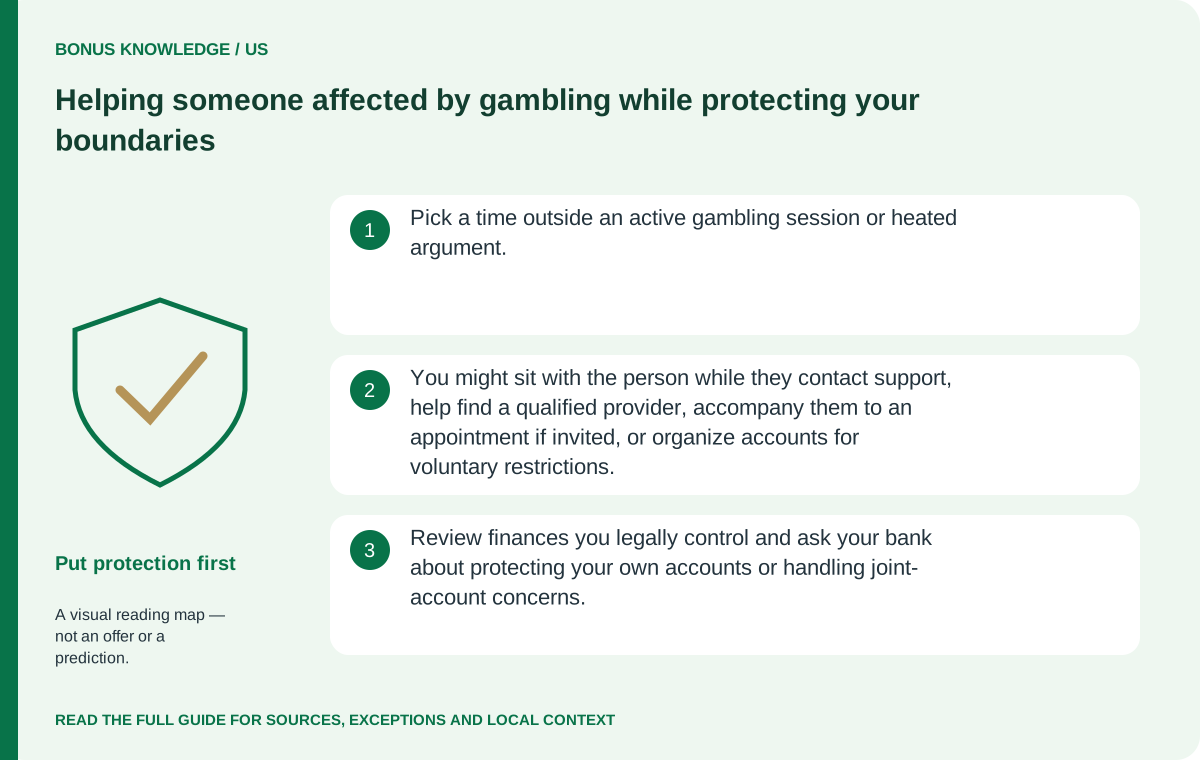
Pick a time outside an active gambling session or heated argument. Explain what you noticed and how it affects you: missed bills, cancelled plans, repeated money requests, or worry about shared finances. 'I am concerned because the rent payment was missed' is easier to discuss than a label or accusation.
Ask an open question such as 'How is gambling affecting you?' and listen. You do not need agreement about a diagnosis to state concerns. Avoid debating a preferred game, odds, or a plan to win everything back; that can pull the conversation toward another gambling decision.
Offer a specific kind of help
You might sit with the person while they contact support, help find a qualified provider, accompany them to an appointment if invited, or organize accounts for voluntary restrictions. Ask what help they want rather than taking control without consent.
NCPG's official help page connects people with local resources. Gam-Anon provides information and peer-support meetings for people affected by someone else's gambling. You may seek family support even if the person gambling declines help or says the situation is not a problem.
Set financial boundaries you can maintain
Be clear about what you will provide. For example: 'I can help arrange an appointment, but I will not lend money for gambling or let my account be used.' Do not share identity documents, payment cards, logins, or authentication codes to keep someone else's account active.
Review finances you legally control and ask your bank about protecting your own accounts or handling joint-account concerns. Joint money, debt liability, separation, and asset ownership can involve legal questions; obtain appropriate advice before moving funds that are not solely yours. Avoid secret surveillance or unauthorized account access.
Separate essential needs from repeated rescue
If children, housing, food, or other essentials are affected, focus on a practical plan for those needs. Assistance should fit your resources and boundaries; you are not required to cover gambling losses. A qualified financial or legal adviser can clarify obligations involving shared debts.
Paying a debt does not itself address the pattern that created it. Avoid making rescue conditional on a promise that you will monitor every future action. Sustainable support needs clearer roles than turning a relative or partner into a full-time investigator.
Know what you can and cannot arrange
Self-exclusion programs commonly require voluntary enrollment; Pennsylvania explicitly says another person cannot place someone on its lists. You can provide instructions or help with a requested application, but should not impersonate the person. Other protective routes must be checked under relevant local rules.
If a conversation becomes threatening or you feel unsafe, step away and seek appropriate local support. For immediate danger, contact local emergency services. Helping someone does not require accepting intimidation or risking your safety.
Arrange support for yourself
Stress, disrupted sleep, financial uncertainty, and broken trust can affect family members independently of whether gambling stops. Consider your own counseling, peer support, or trusted social contact. Keep routines that protect your wellbeing.
Progress may be uneven, and you cannot guarantee another adult's decisions. You can remain respectful, repeat boundaries, and keep the path to help visible. This article provides communication ideas and resources, not a diagnosis, individualized therapy, or legal advice.
Worked example · hypothetical
Hypothetical example
A fictional partner says: 'I will help you call a counselor and review household bills. I will not provide my card or borrow money for another wager.' The support offer is specific, and the financial boundary stays clear.
Common questions
Can I get help if the person gambling refuses treatment?
Yes. Family-support resources can address effects on your life without waiting for the other person to participate.
Can I self-exclude another adult?
Do not impersonate them. Pennsylvania requires voluntary enrollment by the person; check the relevant official program's rules.
Your next useful step
- Find a support contact
Choose a contact route, check its coverage, and ask about suitable local help.
- How to stop gambling: practical first steps in the US
Start with one manageable action without needing to finish a promotion.
- Gambling blocks and self-exclusion: building several barriers
Understand what access restrictions cover and where they leave gaps.
- First-step support guide
Read the contact options and practical first-step plan together.
Sources & further reading
Read the source alongside the explanation. Rules and published terms can change; check the current official position where you live.
- NCPG: Help and treatment
- Gam-Anon International Service Office
- Pennsylvania: Self-exclusion
- Pennsylvania DDAP: Problem Gambling Services
How this topic changes across borders
These links open the relevant local explanation. Where there is no direct equivalent, they lead to that region’s topic library.
UKHelping someone with gambling while looking after yourself →EUHelping someone with gambling while protecting your own wellbeing →